What is the easiest Bible timeline for beginners?
The easiest Bible timeline for beginners is six anchors in order: Abraham, the Exodus, David, the fall of Jerusalem, the birth of Jesus and Paul in Rome; everything else hangs between them. You do not need 200 dates. You need the order, and an honest sense of how sure each date is.
Order first.
Dates second.
Certainty always.
The result: six anchors and how sure each date is
about 2000 to 1800 BC
Abraham leaves Haran
Traditional No outside records name Abraham; the range comes from adding up the Bible's own numbers, and scholars differ.
about 1446 BC or about 1270 BC
The Exodus from Egypt
Debated 1 Kings 6:1 points to the earlier date; many historians favor the later one. Both views are held by careful readers.
about 1010 BC
David becomes king
Approximate Widely used working date, counted back from later kings who can be tied to Assyrian records.
587 or 586 BC
Jerusalem falls to Babylon
Firm Babylonian records let historians fix this within about a year.
about 6 to 4 BC
Jesus is born
Approximate Before Herod the Great died; the BC/AD calendar was worked out centuries later and missed by a few years.
about AD 60
Paul arrives in Rome
Approximate Fixed from the governors named in Acts, give or take a year or two.
Dates are the ranges most commonly given in study Bibles and history references. Where scholars disagree, we say so rather than pick a side.
How to build a Bible timeline in 5 steps
1
Learn the six anchors
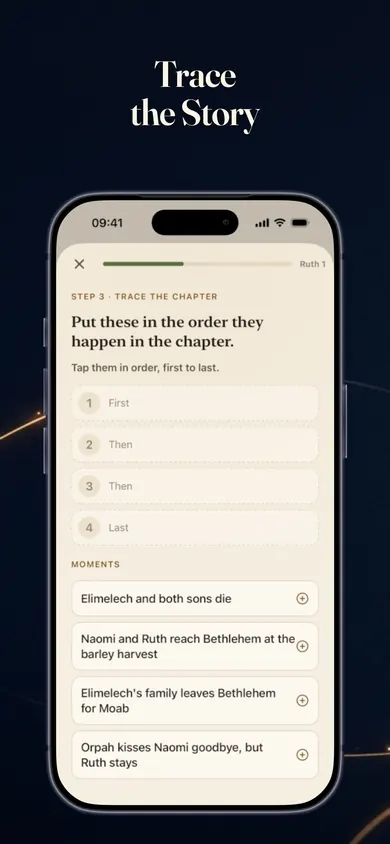
Use the sorter above until you can do it without the arrows. That is your skeleton.
2
Add the eras between them
Patriarchs, then Egypt and the Exodus, the judges, the kings (one kingdom, then two), exile and return, about four hundred quiet years, Jesus, the early church.
3
Hang the books on the eras
Ruth sits in the judges. Jonah sits in the kings. Daniel and Ezekiel sit in the exile. Most of Paul's letters sit inside Acts. The Bible's order of books is by type, not by date.
4
Mark how sure each date is
Firm, approximate, traditional, debated, or undated. Wayfold labels its 27 timeline events this way, so you never mistake a guess for a fact.
5
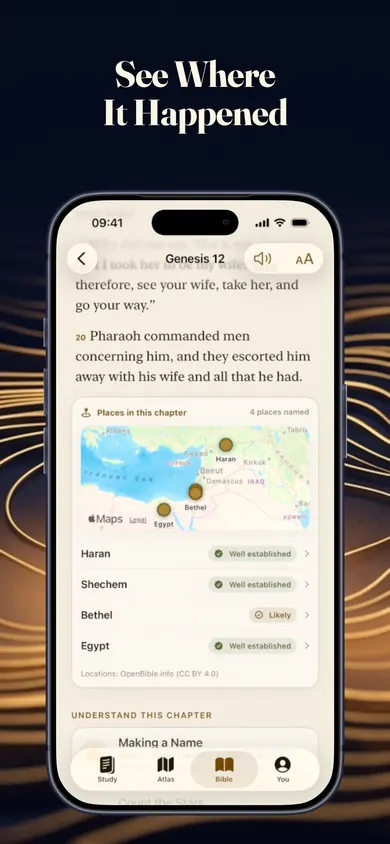
Put it on a map
Abraham walks from Haran to Canaan; Paul sails to Rome. Seeing where turns dates into journeys. Wayfold has 10 journeys to step through, 4 of them free.
Bible timeline questions
What is the best way to learn the Bible timeline for beginners?
Start with a handful of anchor events (Abraham, the Exodus, David, the exile, Jesus, Paul in Rome), learn their order, then hang the eras and books between them. Order first, exact dates later.
How many years does the Bible cover?
From Abraham to the end of Acts is roughly two thousand years, depending on how Abraham is dated. Genesis 1 to 11 sits before that and cannot be given calendar dates.
Are the books of the Bible in chronological order?
Not exactly. They are grouped by type (law, history, poetry, prophets, Gospels, letters). Job, many Psalms and the prophets fit inside the history books' timeline, not after them.
Why do Bible timelines give different dates?
Some events have outside records and firm dates (the fall of Jerusalem). Others depend on how you read the Bible's own numbers (the Exodus). Good timelines say which is which.
What happened between the Old and New Testaments?
About four hundred years passed between Malachi and the birth of Jesus: Persian, Greek and then Roman rule. Catholic and Orthodox Bibles include books from this period, such as 1 and 2 Maccabees; Protestant Bibles do not.
Is there a free Bible timeline app?
Wayfold's Bible timeline of 27 events is free, with each event marked as a firm date, approximate, traditional, debated or undated, alongside the map and 4 of its 10 journeys.
A scenario: the Sunday school question
A ten-year-old asks whether Moses knew King David. The adult answering is not sure. Then the six anchors come back: the Exodus, then the judges, then David. Several centuries apart, whichever Exodus date you hold. "No," the adult says, "but David knew Moses' story the way we know it."
That is what a beginner's timeline is for. Not trivia. A frame that turns a pile of stories into one story.
"But when the fullness of the time came, God sent out his Son, born to a woman, born under the law,"
Galatians 4:4 (World English Bible)
Ways to learn the Bible timeline, compared
| Way | Good at | Weak at |
|---|---|---|
| Chronological reading plan | Shows the story in order as you read it | A year-long commitment; dates rarely explained |
| Printed timeline chart | The whole sweep on one wall | Often prints one date with no note that it is debated |
| This page's six anchors | Ten minutes to a working skeleton | Only six events |
| Wayfold (ours) | 27 events with certainty labels, a map, journeys and verse-linked study | iPhone only; deep studies cover six books; all 10 journeys and 63 lessons need Premium Lifetime |
One design decision we made: Wayfold shows "debated" on a date rather than quietly choosing one. Beginners deserve to know where the solid ground ends.
Open Wayfold in the App Store
The timeline, the map and the Ruth and Jonah studies are free.

Wayfold on the App Store · Updated November 2026
Related
- Wayfold: chapter-by-chapter Bible studyRead a chapter, answer questions, then see the exact verse behind each answer. Ruth and Jonah studies and leader guides are free on iPhone.
- The Christmas story in the Bible, in orderThe Christmas story in the Bible in order: 8 scenes from Luke and Matthew with verses, word counts and a Dec 18-25, 2026 reading plan.
- Best Bible study method for small groups: 4 compared on one passageSOAP, inductive, Discovery Bible Study or question-and-proof? All four worked on Jonah 1:1-3, with prep time and the group each one suits.
- Books in the Catholic Bible but not the Protestant oneThe 7 books (plus longer Esther and Daniel) in Catholic Bibles but not Protestant ones, explained fairly, with a sort-the-books game.