What is spaced repetition for Bible verses?
Spaced repetition for Bible verses means recalling a verse from memory on a widening schedule (today, tomorrow, three days, a week, two weeks, a month) instead of repeating it many times in one night. Each review takes a minute or two. You try first, then check, and the small struggle is what makes it stick.
Students already know this from exam season. a review of 317 experiments by Cepeda and colleagues (2006, Psychological Bulletin) found that spreading study sessions out beats cramming them together for later recall, and Cepeda and colleagues (2008, Psychological Science) showed the best gap grows with how long you want to remember. Verses are verbal material like any other. The research does not make memorizing holy; it just stops you wasting the effort.
“I have hidden your word in my heart, that I might not sin against you.”
Psalm 119:11, World English Bible
How to memorize Bible verses with spacing, in 3 steps
Learn it once, properly
Read the verse aloud three times with the reference. Then cover it and write only the first letter of each word. Recite from the letters until you can say it clean once.
Recall before you look
On each review date, say or write the verse from memory first. Only then check. A wrong word you catch teaches more than ten right readings.
Widen or step back
Clean recall? Move to the next, longer gap. Stumbled? Repeat the same gap. That one rule is the whole system.
Try, then check, then wait a little longer: spacing turns a verse you read into a verse you carry.
Five ways to memorize Scripture, compared
Dunlosky and colleagues (2013, Psychological Science in the Public Interest) rated ten common study techniques. Practice testing and distributed practice came out on top as “high utility”; rereading and highlighting rated low. Here is how that maps onto the usual Bible memory methods.
| Method | How it works | Best for | Weak spot |
|---|---|---|---|
| Rereading | Read the verse many times | Getting familiar | Feels learned, fades fast |
| Writing it out | Copy the verse by hand | Kinesthetic learners | Copying is not recalling |
| First-letter method | Recite from initials only | The first three days | A crutch if you never drop it |
| Flashcards, one sitting | Reference front, verse back | Self-testing | Massed if done all at once |
| Spaced review | Recall on widening dates | Keeping verses for months | Needs a calendar or an app |
Our take for students: first-letter in week one, spaced recall after that, and never rereading on its own.
Your verse review schedule
Pick a verse and a start date. You get the six review dates and a first-letter version to practise from. Nothing is saved or sent anywhere.
Finals week, two verses
Picture a sophomore in December with four exams and a habit of cramming. She tries to learn Philippians 4:6-7 the way she studies organic chemistry: twenty readings the night before. It holds for two days. In January she tries again with spacing: five minutes on a Sunday, then a minute on the bus Monday, Wednesday, the next Sunday, two weeks later. By February she can say it in the waiting room before a hard conversation, without trying.
An illustrative scenario, not a user story.
Where Lampstep fits
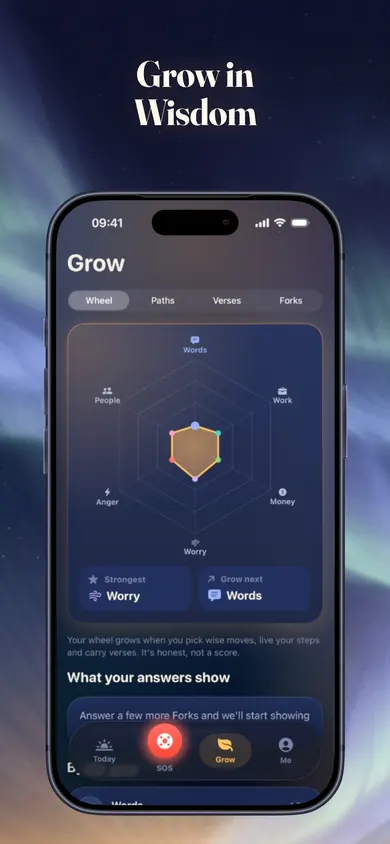
We make Lampstep, a daily Bible verse app for real-life moments. Its Ready Verses come with Bible memory games and spaced review, so the schedule above runs without a calendar. You can carry 3 verses free, or all 176 with Lampstep Plus.
The rest of the app is about using a verse, not just storing it: a daily Fork (a real situation with 3 or 4 honest choices), the verse behind the wise move, one small step, and an always-free SOS for anxious or angry moments.
Free vs Plus: SOS, today's Fork, the evening check-in and Proverb of the Day are free forever. Plus (yearly $49.99 with a 14-day free trial, family $69.99, monthly $9.99 or lifetime $129.99 in the US) adds every Fork, all Paths, unlimited Ready Verses and Tomorrow Prep.
One design call: no AI, no account, no servers. Your answers stay on your phone. One limit: it is World English Bible only.
Pick something else if you want to memorize whole chapters or choose your translation: a dedicated memory tool such as Remember Me or BibleMemory.com is built for exactly that.
Scripture memory questions
What is spaced repetition for Bible verses?
It means reviewing a verse on a widening schedule (for example today, tomorrow, in 3 days, a week, two weeks and a month) instead of repeating it many times in one sitting. Each review is a quick recall from memory, then a check.
Is spaced repetition better than cramming?
For remembering a verse weeks later, yes. Learning research consistently finds spread-out practice beats massed practice for long-term recall, and Dunlosky and colleagues (2013) rated distributed practice and self-testing as the two most useful study techniques they reviewed. Cramming can get you through tomorrow, then fades.
How many times do I need to review a verse?
There is no fixed number. Five or six spaced reviews over a month is a common starting schedule; drop back a step whenever you stumble and keep going until recall feels easy.
What is the first-letter method?
You write only the first letter of each word (“Ihhywimh…” for Psalm 119:11) and recite from those letters. It is a halfway step between reading and full recall, useful in the first few days.
Can I use Anki or flashcards for Bible verses?
Yes. Any spaced-repetition flashcard tool works if you type the verse yourself and keep the reference on the front. Dedicated Bible memory apps add translations and games on top.
Does Lampstep have Bible memory?
Yes. Lampstep's Ready Verses come with Bible memory games and spaced review. You can carry 3 verses free, or all 176 with Lampstep Plus, according to its App Store listing.
Which translation is used here?
Every verse on this page is quoted word for word from the World English Bible, which is in the public domain. Lampstep quotes the same translation.
Open Lampstep in the App Store
Three Ready Verses free, one honest Fork a day.

Open Lampstep in the App Store
Updated November 2026 · Scripture: World English Bible (public domain)
Related
- Lampstep: a Bible verse for real-life momentsAnxious, angry or awake at 3 a.m.? Lampstep's free SOS gives you one Bible verse, one breath and one next step in 90 seconds. Free on iPhone.
- Best Bible app for college students, comparedYouVersion, Dwell, Bible Chat and Lampstep compared for students: free tiers, school-year cost, account, offline. Checked against listings Nov 2026.
- Bible verses about impulse buying, plus a 4-question quizBible verses about impulse buying for the 1 a.m. cart, the sale timer and the bad-day reward. Take a 4-question quiz to pick your waiting rule.
- Bible verses for when a coworker takes creditA coworker took credit for your work? 15 Bible verses quoted word for word, what each one does and doesn't say, and a 90-second cool-down.