For anyone sure their anger is justified: tap the side that's true of yours, six times.
Righteous anger compared with sinful anger across six tests
Test
Righteous
Sinful
About
Speed
Target
Goal
Length
Control
0 righteous · 0 sinful · tap one side per row
Free on iPhone
What is the difference between righteous anger and sinful anger?
Righteous anger is aimed at a real wrong, rises slowly, stays under your control and wants things repaired; sinful anger is aimed at a person, arrives instantly, wants payback and gets kept and replayed. The cause can be right while the anger is still wrong. That is why the table above asks six questions instead of one.
Updated November 2026 · Scripture quoted word for word from the World English Bible (public domain), labeled
Righteous anger questions, answered
Is anger a sin?
Not by itself. Scripture says “Be angry, and don’t sin” (Ephesians 4:26), which only makes sense if the two can be separated, and it calls God “slow to anger” (Psalm 103:8), not never angry. But the same Bible lists “outbursts of anger” among the deeds of the flesh (Galatians 5:20). The feeling is not the problem; what it is about and what you do with it is.
What is righteous anger?
Anger at a real wrong, especially a wrong done to someone else, that stays under control and aims to set things right. Nehemiah is a clear example: he was “very angry” at leaders exploiting the poor, then “consulted with myself” before confronting them (Nehemiah 5:6-7). He paused, then acted to fix it.
Did Jesus get angry?
Yes. Mark 3:5 says he looked around “with anger, being grieved at the hardening of their hearts,” and John 2 describes him driving the sellers out of the temple. It is just as telling what did not make him angry: at his own trial, “When he was cursed, he didn’t curse back” (1 Peter 2:23). His anger was for others, not for his ego.
What does “be angry and don't sin” mean?
Paul is quoting Psalm 4:4 from its Greek translation. (The World English Bible, translating the Hebrew, reads that verse “Stand in awe, and don’t sin.”) Paul's point is practical: you will feel anger, so deal with it quickly, before sundown, and don't give it room to grow into something worse.
How can I tell if my anger is righteous?
Run the six tests in the table above: what it is about, how fast it came, who it targets, what it wants, how long you keep it, and who is steering. Most real anger is mixed. A right cause can still carry a sinful edge, and that edge is the part to deal with first.
What does Matthew 5:22 say about anger?
The World English Bible reads “everyone who is angry with his brother without a cause will be in danger of the judgment.” Many modern translations leave out “without a cause” because the earliest Greek manuscripts do not have it. Either way, Jesus treats contempt and name-calling as serious.
Is it okay to be angry at God?
The Psalms are full of honest complaint: “How long, LORD? Will you forget me forever?” (Psalm 13:1). Christian traditions generally treat telling God the truth as prayer, not rebellion. Lament keeps talking to God; bitterness stops.
What do different Christian traditions teach about anger?
Catholic teaching lists anger among the capital sins and also says that anger aimed at correcting wrong and maintaining justice can be praiseworthy (Catechism of the Catholic Church, paragraph 2302). Orthodox writers stress stillness and watching the thoughts that feed anger. Many Protestant teachers draw the same line through Ephesians 4:26. The broad agreement is striking: the cause matters, and so does the control.
Who this page is not for
If anger has turned into threats, hitting, breaking things, or people at home feeling afraid of you, a table of tests is not enough. Talk to a counselor or your doctor this week. If someone is in danger, call 911. In the US, the National Domestic Violence Hotline answers at 1-800-799-7233, and 988 answers call or text in a crisis. This is general information, not medical advice. Talk to your clinician.
Vent it, stuff it, or bring it: a comparison
Vent it
Feels honest. Usually hits the nearest person, not the actual problem.
Stuff it
Looks calm. Comes back as sarcasm, silence or a blow-up three weeks later.
Replay it
Rehearsing the argument in the shower. Keeps the anger fed long past sundown.
Bring it
Name it to God, slow it down, aim it at the wrong, act to repair. Nehemiah's route.
Anger is a signal, not a steering wheel.
The six tests of righteous anger, with verses
Here is what each row of the table means, and where it comes from.
1About: a real wrong to someone or my pride or comfort?
Jesus' anger in Mark 3 was aimed at hard hearts that would rather keep a rule than see a disabled man healed. It was about someone else's good.
World English Bible“When he had looked around at them with anger, being grieved at the hardening of their hearts, he said to the man, “Stretch out your hand.”” Mark 3:5
2Speed: slow to rise or instant?
God himself is described as slow to anger, and James tells us to be the same. Anger that arrives before you have the facts is rarely on God's side.
World English Bible“let every man be swift to hear, slow to speak, and slow to anger; for the anger of man doesn’t produce the righteousness of God.” James 1:19-20
3Target: the wrong itself or the person?
Paul lists the forms anger takes when it turns on people: bitterness, outcry, slander, malice. Then he names the opposite.
World English Bible“Let all bitterness, wrath, anger, outcry, and slander be put away from you, with all malice. And be kind to one another, tender hearted, forgiving each other,” Ephesians 4:31-32
4Goal: repair or protect or payback?
Righteous anger wants the wrong fixed. Sinful anger wants the other person to hurt. Scripture leaves the payback part to God.
World English Bible“Don’t seek revenge yourselves, beloved, but give place to God’s wrath.” Romans 12:19
5Length: settled soon or kept and replayed?
Anger that stays overnight, every night, stops being a response and becomes a resident.
World English Bible““Be angry, and don’t sin.” Don’t let the sun go down on your wrath, and don’t give place to the devil.” Ephesians 4:26-27
6Control: i'm steering it or it's steering me?
Proverbs rates self-control above military strength. If you can't choose your next word, the anger is in charge.
World English Bible“One who is slow to anger is better than the mighty; one who rules his spirit, than he who takes a city.” Proverbs 16:32
Make it a habit with Lampstep
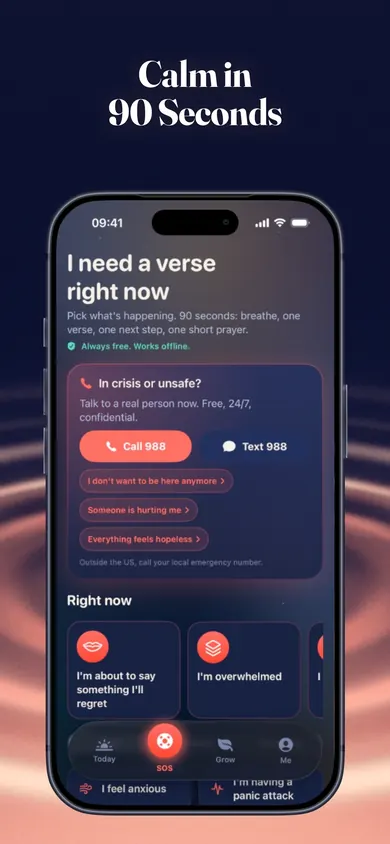
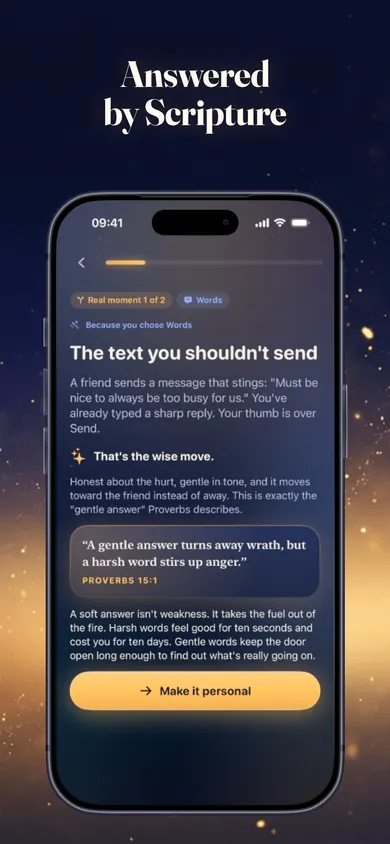
We make Lampstep, a daily Bible verse app built for moments like this. When anger is rising, its SOS gives you gentle breathing with haptics, then one verse, one next step and one short prayer in about 90 seconds. SOS is always free, works offline and is one tap from the app, a widget or Siri. You can also pick Anger as your hardest area, and the Anger to Peace path walks through it over several days (first days free, the full path with Lampstep Plus).
SOS: pick what is happening, get one verse and one step.The reveal: the verse word for word, then a plain why.
Honest limits: Lampstep is not counseling or anger management therapy. It quotes only the World English Bible, runs only on iPhone, and keeps everything on your phone with no account. A decision we made on purpose: it never labels your choice “wrong”; it shows the move that fits best and why.
A dad, a coach and a bench
A father watches his son sit out a whole game for no reason he can see. By the drive home he has a text drafted to the coach. Run the table: About? Partly his son, partly his own embarrassment in the stands. Speed? Instant. Target? The coach as a person. Goal? Honestly, to make the coach feel small.
Two righteous marks, four sinful. The cause might still be fair. So he waits until morning, asks his son what happened, and sends one calm question asking to talk. Same concern, different anger.
Make it a habit with Lampstep
Keep SOS one tap away for the next time the heat rises.
Lampstep: a Bible verse for real-life momentsAnxious, angry or awake at 3 a.m.? Lampstep's free SOS gives you one Bible verse, one breath and one next step in 90 seconds. Free on iPhone.
Should I send this angry text? Free heat checkPaste your draft and get an instant heat check, then fix the 7 mistakes that make angry texts worse, each with a Bible verse. Runs on your device.
Bible verses before a difficult conversationA hard talk coming up? Pick who it's with and when. Get one verse, one opening line and a live countdown plan. Scripture from the WEB.